[NAME]
Utkarsh Gangwal, Ph.D.
Postdoctoral Research Associate
University of Virginia

About Me

I am a Postdoctoral Research Associate in the Civil Engineering Department at the University of Virginia, working in the lab of Dr. Majid Shafiee-Jood. My research focuses on evacuation modeling, behavioral analysis, and disaster AI.

I completed my Ph.D. from the University of Delaware under the guidance of Dr. Shangjia Dong at the Dong Research Lab, and received multiple research awards along with Doctoral Fellowship for Excellence. My doctoral research, titled “Integrating Adaptive Capacity in Interdependent Human-Infrastructure Systems for Disaster Resilience,” examined how human behavior and large-scale infrastructure systems interact during disasters and how household adaptive capacity can be incorporated into resilience planning. I was also affiliated with the Disaster Research Center, a hub for interdisciplinary disaster science scholars and practitioners.

I completed my undergraduate studies in Civil Engineering with honors at the Indian Institute of Technology Gandhinagar (IITGN). I was awarded the Director’s Gold Medal for outstanding overall performance and the Institute Gold Medal for achieving the highest cumulative performance index in my discipline. During my time at IITGN, I worked under the guidance of Dr. Udit Bhatia in the Machine Intelligence & Resilience Lab, where I studied robust and resilient networked infrastructure systems.

Research Interests

  • Interdependent Human-Infrastructure Modeling
  • Evacuation Modeling
  • Disaster AI
  • Behavior Analysis
  • Community Resilience

Education

PhD, Transportation and Civil Infrastructure Systems
2021 - 2026
University of Delaware
BTech, Civil Engineering
2017 - 2021
IIT Gandhinagar

Methods

  • Network Modeling
  • Machine Learning
  • Deep Learning
  • Optimization
  • Survey Analysis & Econometric Modeling
  • Agentic AI

Research

Coupled Human-Infrastructure Systems

Coupled human-infrastructure systems capture the intricate interdependencies between communities and the infrastructure they rely on. These systems are shaped by how individuals and communities use infrastructure, depend on it, and experience its failures, especially during times of disruption. Disasters often expose disparities in resilience, as households—such as those with limited mobility, economic resources, or access to services—face heightened risks due to their constrained ability to prepare for, respond to, and recover from events.

My research focuses on developing modeling frameworks that simulate these interdependencies to better understand the dynamics of socio-technical systems. Using system dynamics and complex network-based approaches, we explore both infrastructure-to-human and human-to-infrastructure feedback during disasters. This integration enables us to analyze how human behavior affects infrastructure performance and vice versa, ultimately offering insights into how targeted interventions can enhance community resilience.

Household Adaptation and Predictive Modeling

Households depend on infrastructure systems for essential services, and during disruptions, they often adapt by adjusting their demand or supplementing supply to lessen the impact. These adaptations—whether planned or spontaneous—play a critical role in maintaining household functioning and resilience, serving as a bridge between infrastructure performance and community well-being during crises. Understanding these behaviors is vital for supporting equitable and effective disaster response.

This research aims to characterize and predict household adaptations during infrastructure service interruptions using econometric models and machine learning techniques. By capturing how and when households implement various adaptations, the study provides insights for system operators, emergency managers, and community organizations to better incorporate adaptive behaviors into planning, restoration efforts, and resource allocation.

Critical Facility Accessibility and Road Criticality

Critical facility accessibility is essential for disaster response and recovery, yet road networks often provide uneven access across communities. Disruptions such as flooding can isolate populations from essential services or significantly increase travel times, disproportionately affecting communities at risk. This research adopts an integrated network-based approach to evaluate accessibility by accounting for partial road failures, multiple types of critical facilities, and changes in travel time during flood events.

Some roads play a disproportionately important role in maintaining access to these critical facilities. To increase disaster resilience, my work involves identifying the most critical roads for protection and early recovery. While certain segments are frequently used in post-flood travel routes, others are vital for preserving access to avoid formation of service deserts. My research combines complex network-based approaches with optimization techniques on large-scale networks to identify and prioritize essential roads for protection and early recovery.

Featured Projects

2025-2026
Modeling cascading failure in human-infrastructure system during hurricane

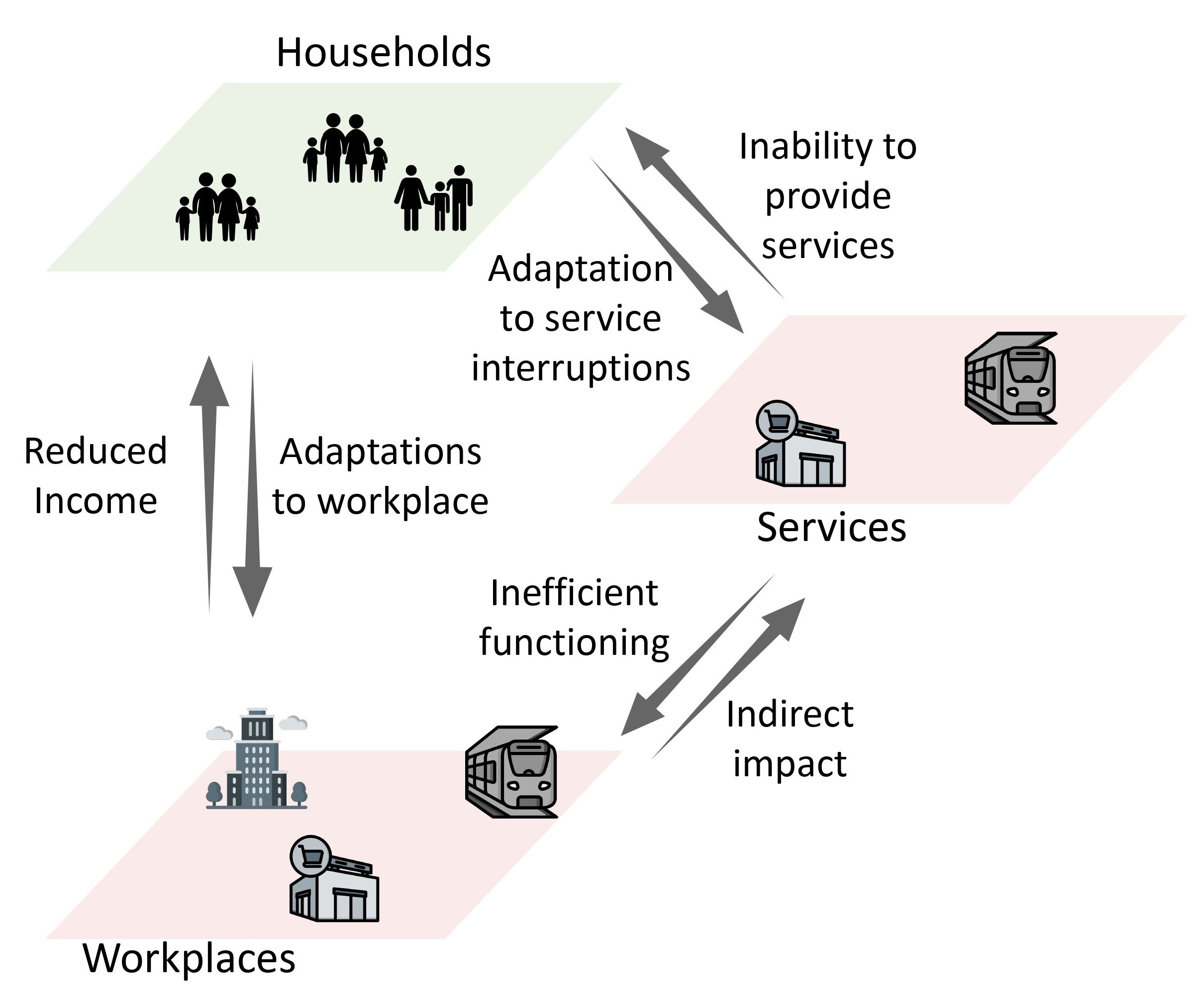
The study involves developing coupled human-infrastructure system to model the cascading failures across households, workplaces, and services provided to the wider community during disaster events. A data-fusion framework is developed using optimization techniques, statistical methods, and deep neural network, to construct the multilayered network using various datasets, including the synthetic population, NSI building data, LEHD LODES data, and human mobility-data. The household adaptative capacity to work disruption is integrated to evaluate the reduced workforce and impact to communities that rely on various services.

Dr. Shangjia DongOngoing
2023 - 2024
Multi-event cross-region analysis of household adaptation to infrastructure service disruption

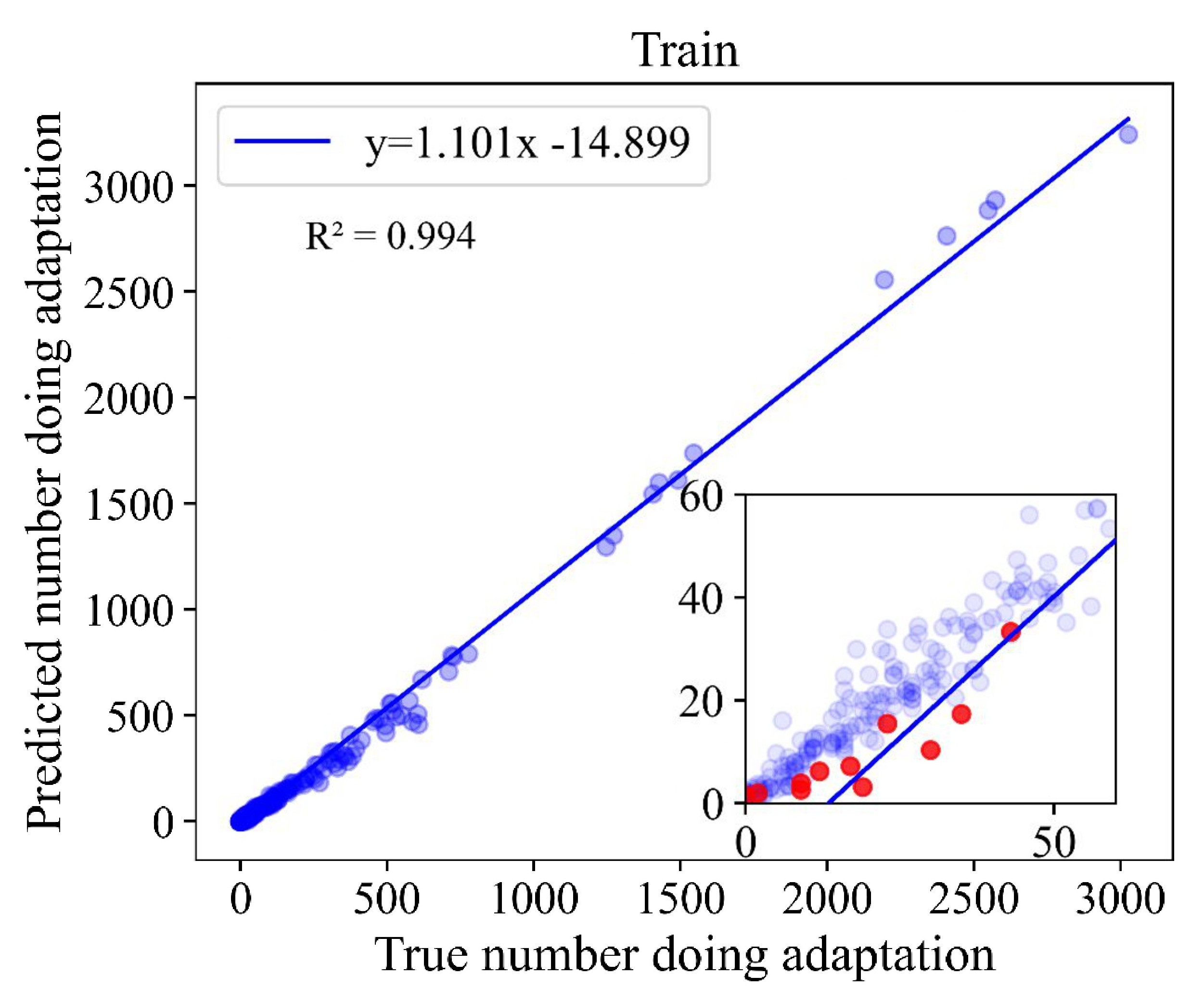
This project investigated household adaptation to infrastructure service disruptions across multiple disaster events and geographic regions. Mixed logit models were used to examine how adaptation decisions are associated with outage duration and individual characteristics, while cross-region comparisons assessed the prevalence of different adaptations under both past experiences and anticipated future disasters. The models were also evaluated for their ability to predict the number of individuals likely to adopt specific adaptations, providing insights into household behavioral responses to prolonged infrastructure disruptions.

Dr. Shangjia Dong, Dr. Rachel Davidson, Dr. James Kendra, Dr. Bradley EwingCompleted
2025-2026
Modeling workforce disruption through household adaptation during hurricanes

A cluster-specific XGBoost framework was developed to predict household changes in work participation during hurricane events. Using household survey data from North Carolina and Florida, the study examined how infrastructure disruptions, job characteristics, employer constraints, and competing household responsibilities shape work-related decisions. Supporting adaptations, including strategies for managing and reallocating caregiving responsibilities, were analyzed across different time periods to understand how households sustain work participation. The predictive framework was evaluated across time intervals and industries to assess its ability to capture variations in household responses.

Dr. Shangjia DongCompleted
2022
Critical facility accessibility and road criticality assessment during flooding

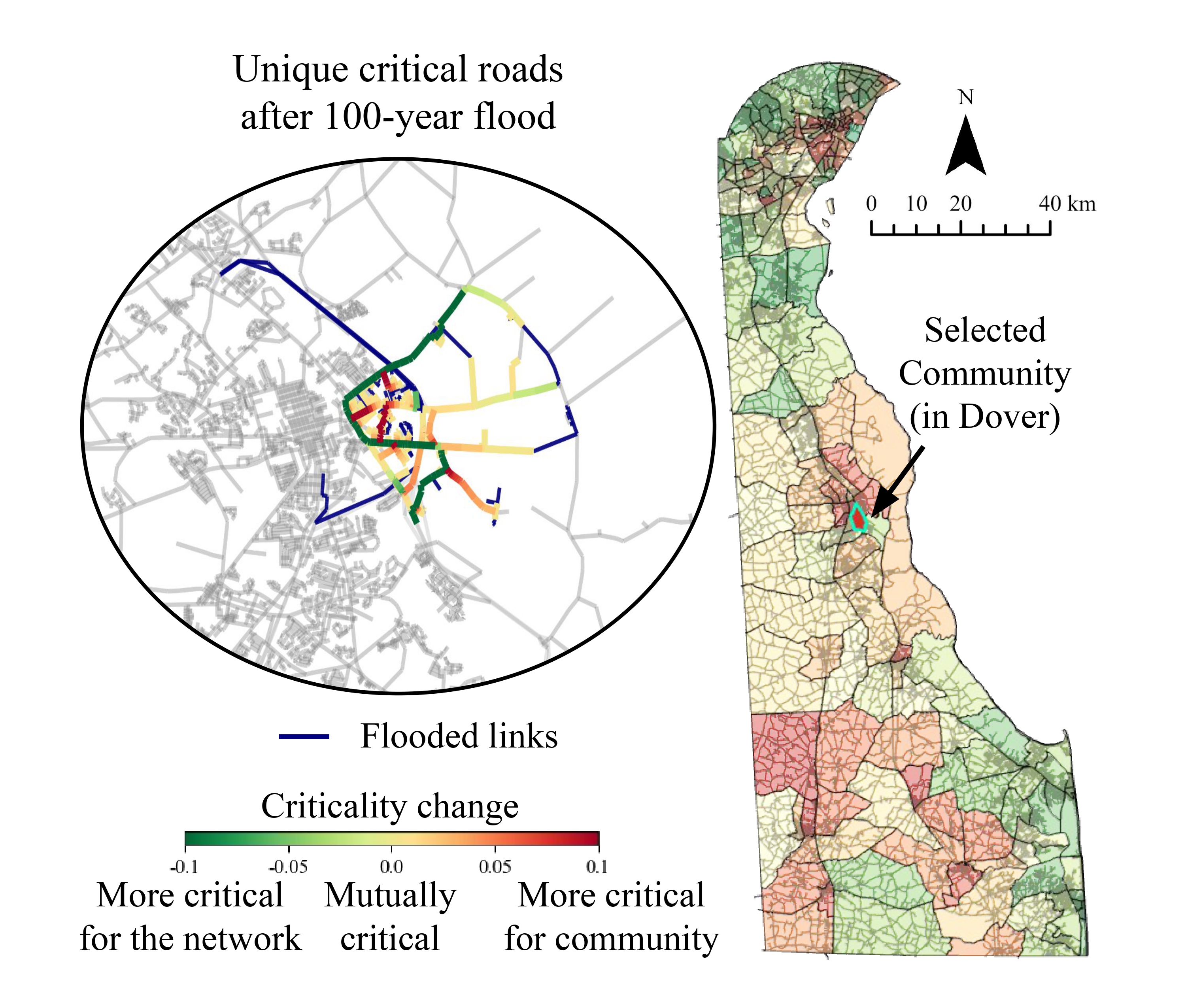
The project assessed accessibility disparities to critical facilities across Delaware under flooding scenarios that account for partial road failures. A depth-disruption function was integrated into travel-time calculations to quantify changes in accessibility, while a modified betweenness centrality measure was used to identify roads critical for maintaining access to critical facilities for both the transportation network and census block groups. A weighted criticality metric was also developed to identify flooded roads that are particularly important for reconnecting disconnected communities and restoring access to critical facilities.

Dr. Shangjia Dong, Dr. AR Siders, Dr. Jennifer HorneyCompleted

Publications

Journal Articles
  • Lights out, decisions on: How households adapt to power outages across regions and events. Utkarsh Gangwal, Rithika Dulam, Shangjia Dong, Rachel A Davidson, James Kendra, Bradley Ewing, Adam Andresen.
    Energy Research & Social Science · 2025 · doi:10.1 016/j.erss.2025.104162
  • Living with and without water: modeling human-infrastructure interactions in disaster preparedness. Utkarsh Gangwal, Shangjia Dong, Fengyan Shi.
    Urban Informatics · 2025 · doi:10.1007/s44212-025-00072-0
  • A deep generative framework for joint households and individuals population synthesis. Xiao Qian, Utkarsh Gangwal, Shangjia Dong, Rachel Davidson.
    Applied Soft Computing · 2025 · doi:10.48550/arXiv.2407.01643
  • Characterizing and predicting household adaptations to electric power outages. Rithika Dulam, Utkarsh Gangwal, Rachel A Davidson, Shangjia Dong, Bradley Ewing, James Kendra, Adam Andresen.
    Urban Informatics · 2025 · doi:10.1007/s44212-025-00082-y
  • Flood inundation and isolation differentially impact access to dialysis care. Jennifer A Horney, Utkarsh Gangwal, Shangjia Dong.
    American journal of disaster medicine · 2024 · doi:10.5055/ajdm.0490
  • Critical facility accessibility and road criticality assessment considering flood-induced partial failure. Utkarsh Gangwal, AR Siders, Jennifer Horney, Holly A Michael, Shangjia Dong.
    Sustainable and Resilient Infrastructure · 2023 · doi:10.1080/23789689.2022.2149184
  • Characterizing resilience of flood-disrupted dynamic transportation network through the lens of link reliability and stability. Shangjia Dong, Xinyu Gao, Ali Mostafavi, Jianxi Gao, Utkarsh Gangwal.
    Reliability Engineering & System Safety · 2023 · doi:10.1016/j.ress.2022.109071
  • Ensuring access to opioid treatment program services among Delawareans vulnerable to flooding. Jennifer A Horney, Sarah Elizabeth Scales, Urkarsh Gangwal, Shangjia Dong.
    Delaware Journal of Public Health · 2023 · doi:10.32481/djph.2023.06.024
  • Critical facility accessibility rapid failure early-warning detection and redundancy mapping in urban flooding. Utkarsh Gangwal, Shangjia Dong.
    Reliability Engineering & System Safety · 2022 · doi:10.1016/j.ress.2022.108555
  • Identifying early-warning indicators of onset of sudden collapse in networked infrastructure systems against sequential disruptions. Utkarsh Gangwal, Mayank Singh, Pradumn Kumar Pandey, Deepak Kamboj, Samrat Chatterjee, Udit Bhatia.
    Physica A: Statistical Mechanics and its Applications · 2022 · doi:10.1016/j.physa.2 021.126796
Conference Proceedings
  • Are opioid treatment programs ready for disaster? the growing risk of flood-associated isolation. Jennifer Horney, Shangjia Dong, Utkarsh Gangwal.
    APHA 2024 Annual Meeting and Expo · 2024
  • Fire Station Accessibility, Assessment, and Improvement Considering Probabilistic Road Failure in Facing Flooding. Jiaji Ma, Utkarsh Gangwal, Shangjia Dong.
    ASCE Inspire · 2023 · Washington DC · doi:10.1061/9780784485163.096
Survey Instruments
  • Survey Instruments to Collect Revealed and Stated Preferences for Household Adaptations & Unhappiness During Extreme Events.
    DesignSafe · 2025 · doi:10.17603/ds2-35nr-pj53